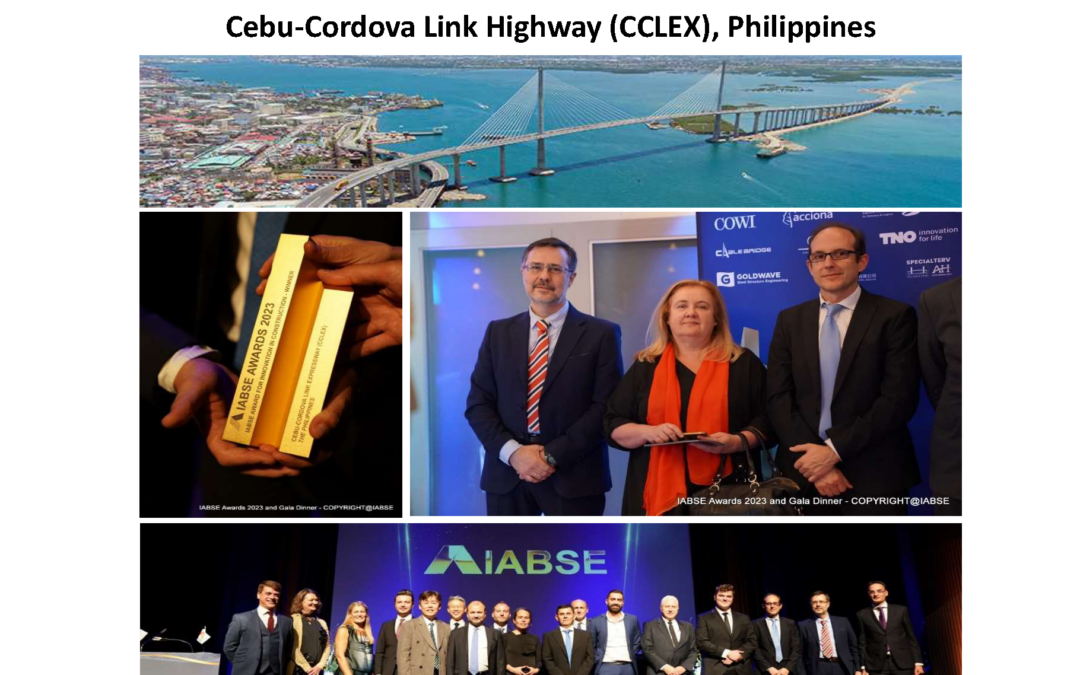
The Cebu-Cordova link highway stands as an outstanding landmark in Philippine infrastructure, being both the longest and the highest bridge in the country. This project not only redefines connectivity, but also plays a crucial role in providing an essential transport link that has a significant impact on mobility nationwide
The centerpiece of this architectural feat is the elegant cable-stayed bridge, an imposing structure that not only stands out for its aesthetic magnificence, but also for its functionality. The substantial reduction in travel times will not only improve comfort for users, but will also have obvious economic implications
Its grandeur was not without significant technical challenges for designers and builders. The region, characterized by high seismicity, posed a number of challenges that demanded ingenious solutions. Seismic resistance and the ability to respond to its potential events were paramount considerations in structural design. The need to ensure the safety of the infrastructure and those who use it prompted the implementation of advanced and novel
construction methods and technologies
In the project, ERSIGROUP as a provider of detailed engineering in the field of reinforcing steel (BIM and Shop Drawings) faced a number of very significant challenges that required very detailed attention and innovative solutions. Key challenges included:
- Variable section pylon construction system
Design of two execution systems: Initially with four precast elements and later with two when the cross-section is significantly reduced
Ensuring continuity of vertical bars: The use of an adaptable mould with precise geometric control is essential to ensure structural integrity throughout its variability
Reducing the need for manual labour at heights: Minimizing manual intervention at elevated heights by implementing technologies and methods that improve safety and work efficiency
Design of asymmetric lifting handles : Ensure correct assembly of the element, including welding requirements - Avoid collision between assembled and embedded
Use 3D modelling to prevent collisions between reinforcement and embedded elements, especially in elements with unique geometry such as pile caps, capitals and prefabricated panels - Solving reinforcement problems in octagonal pylon pile caps
Corner reinforcement joints: Precisely resolve the reinforcement joints at the corners of the octagonal pile caps
Reinforcement connections with pile reinforcement: Addressing the challenges associated with connecting pile reinforcement with pile reinforcement
Millimeter tolerance of the shear reinforcement: Ensure millimeter accuracy of the shear reinforcement in order to carry out the concreting in two phases - Collision analysis and alternative proposals
Identify and resolve collision problems at the critical connection element between the pylon and the bridge deck
Definition of implementation sub-phases: To facilitate the correct step-by-step completion of this critical element - Typical reinforcement optimization challenges
Reinforcement Optimization: Search for efficiencies in reinforcement design to improve strength and reduce costs
Reinforcement preparation according to element execution logic: Align reinforcement preparation with the execution logic of each element to ensure efficient construction
Overcoming these challenges required a holistic approach that involved close collaboration between design and construction teams on the project. The implementation of advanced technologies, such as 3D modelling, and meticulous attention to detail were essential to ensure
the success of the Cebu-Cordova bridge project